Computer vision research · Case study
Gait Phase Classification
A reproducible research workspace for subject-independent four-phase gait classification across visible and thermal silhouette sequences, with data inventory, annotation QA, leakage-controlled splits, model contracts, and subject-level evaluation.
 Computer vision research
Project overview
Gait Phase Classification
A reproducible research workspace for subject-independent four-phase gait classification across visible and thermal silhouette sequences, with data inventory, annotation QA, leakage-controlled splits, model contracts, and subject-level evaluation.
- Context
- Publication-oriented gait research workspace
- Role
- Researcher and developer
- Target
- Four operational gait phases
- Data
- Visible and thermal silhouette sequences
- Status
- Not publication-ready; annotation and final experiments remain
The problem
Temporal classification needs subject separation and trustworthy labels
Gait-phase models can look strong while leaking subject identity across splits or relying on labels that have not been adjudicated. The research workspace makes inventory, annotation quality, split construction, model contracts, and subject-level evaluation explicit before final claims are made.
The system
From dataset audit to leakage-controlled temporal evaluation
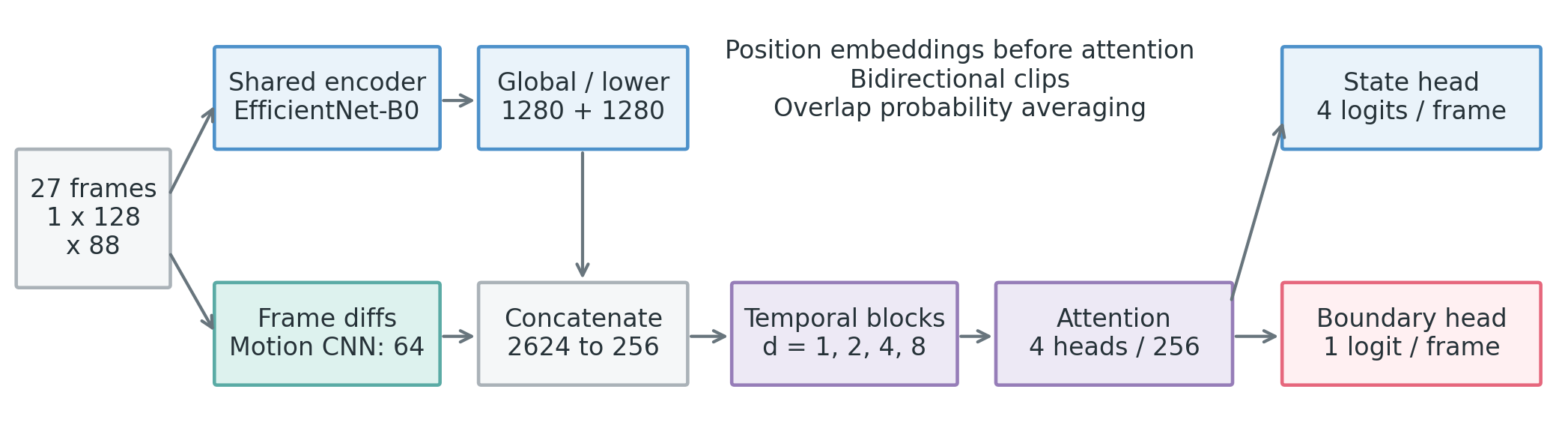
The pipeline organizes data inventory and annotation QA, constructs subject-independent manifests, defines baseline and model contracts, and prepares temporal experiments with separate state and boundary predictions. Current results remain provisional until expert labels and frozen experiments are complete.
What I built
Reproducibility infrastructure around a difficult label
Added data inventory and provenance checks for visible and thermal silhouette sequences.
Defined a four-phase operational label space: initial contact/loading, mid-stance, terminal stance/pre-swing, and swing.
Prepared annotation QA, duplicate review, and explicit provisional-label handling before model claims.
Structured subject-independent development and held-out manifests to reduce identity leakage risk.
Defined model and evaluation contracts for visual features, temporal context, state logits, and boundary predictions.
Generated reproducibility and paper-asset workflows while keeping the project status honest: final labels and experiments are still in progress.
Quality and evaluation
The critical path is evidence, not a headline accuracy number
The repository is an engineering and research framework, not a completed publication result. Historical accuracy claims are not reused as current evidence.
Publication-ready conclusions require expert annotation and adjudication, frozen manifests, registered baselines, leakage-controlled temporal experiments, and subject-level reporting.
Technology
Evidence