Robotics simulation · Case study
Autonomous Robot Environment
A local, simulation-first MuJoCo environment for a two-wheeled robot navigating a furnished office with lidar, camera sensing, dynamic cat obstacles, a safety layer, and a Gymnasium interface for controllers and learning agents.
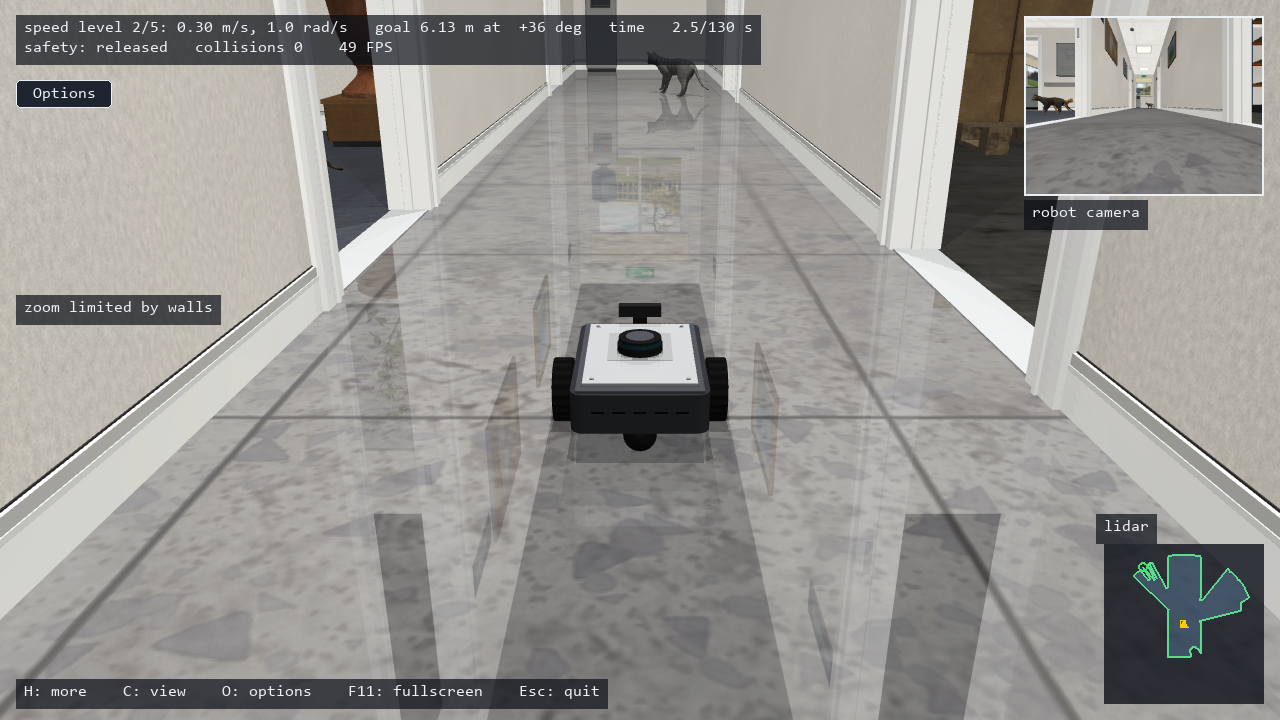 Robotics simulation
Project overview
Autonomous Robot Environment
A local, simulation-first MuJoCo environment for a two-wheeled robot navigating a furnished office with lidar, camera sensing, dynamic cat obstacles, a safety layer, and a Gymnasium interface for controllers and learning agents.
- Context
- Open-source robotics simulation
- Role
- Developer and system designer
- Robot
- Differential-drive base with lidar, camera, and wheel encoders
- Environment
- Furnished office with doorways and roaming or sitting cats
- Status
- Local simulator; no hosted live demo
The problem
Navigation research needs repeatable environments and explicit safety behavior
Autonomous navigation experiments are difficult to compare when sensing, obstacles, control, and safety behavior are scattered across ad-hoc scripts. A repeatable simulator makes the robot, scene, observations, and intervention rules inspectable before a physical deployment is considered.
The system
A simulation loop with safety at the control boundary
The environment exposes the same robot and safety layer to manual control, a baseline driver, and Gymnasium-compatible controllers or learning agents. Automatic commands pass through the safety layer before reaching the simulated robot.
What I built
A practical foundation for simulation-first autonomy
Built a differential-drive robot model with driven wheels, ball casters, lidar, camera sensing, and wheel encoders.
Created a furnished office scene with corridors, rooms, doorways, furniture, and dynamic cat obstacles.
Exposed the environment through a Gymnasium interface so controllers and learning agents can use the same simulator.
Kept safety intervention at the command boundary instead of treating it as an after-the-fact metric.
Included manual and baseline-driver paths for inspecting navigation behavior before training or hardware transfer.
Documented local setup, simulator scope, and the boundary between simulation evidence and physical-robot validation.
Quality and evaluation
Simulation evidence is useful only when its boundary is clear
The repository is a local simulator for repeatable development and research experiments. Its current evidence does not establish performance on a physical robot or a hosted live demo.
Evaluation can compare navigation behavior, safety interventions, and recovery across controlled scenes and controllers while preserving the same environment interface.
Technology
Evidence